
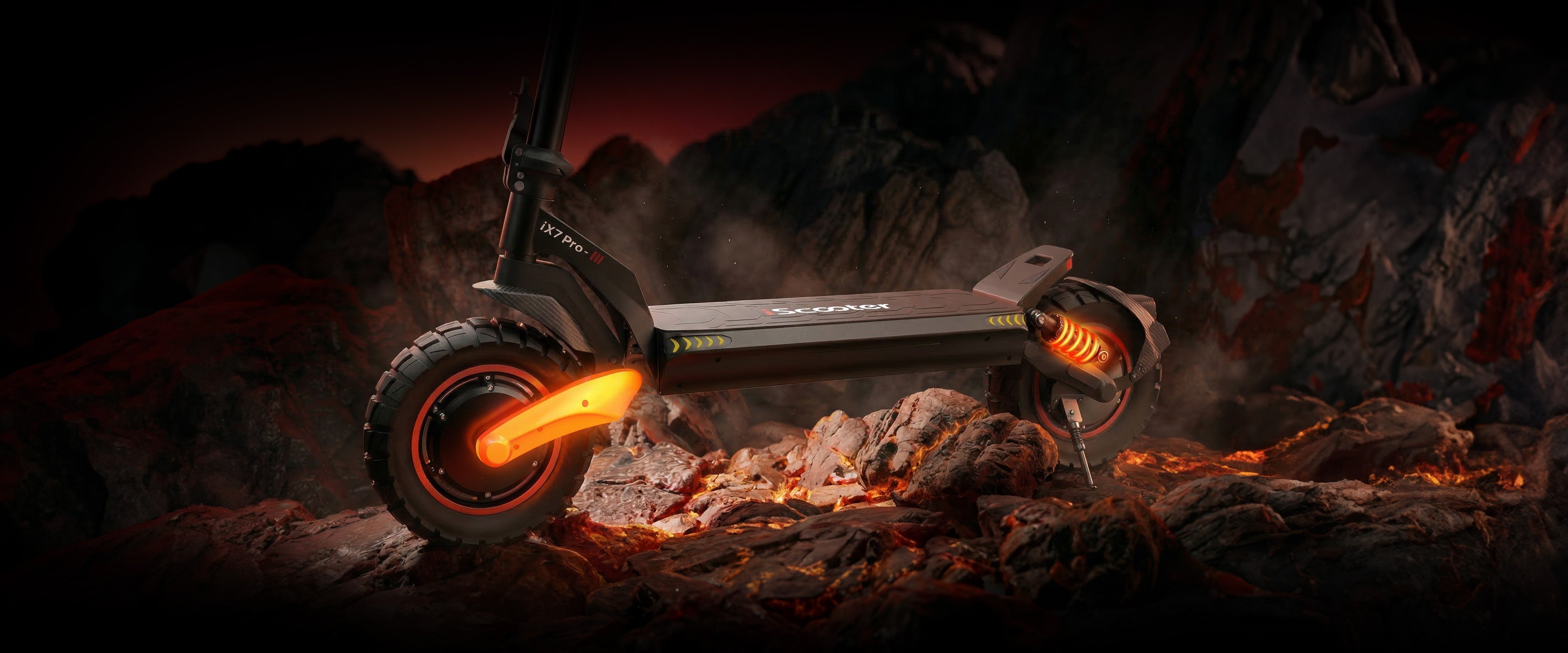
If you've ever hit a pothole on a scooter with zero give in the frame, you already know why an electric scooter with suspension isn't just a nice-to-have. It's the difference between a ride that jolts your wrists on every crack in the pavement and one that actually feels controlled.
iScooter builds its models around that idea: suspension, braking, and balance working together rather than top speed doing all the heavy lifting. This article breaks down how those systems actually function, what to look for if you're comparing a heavy duty electric scooter against something lighter, and where safety features matter most once you're out riding on your own land.
Why Suspension Matters More Than Top Speed
Most first-time buyers fixate on top speed; but speed on its own doesn't tell you much about how a scooter actually rides once the road gets rough and in the UK, "rough" is basically the default. Cracked tarmac, raised drain covers, gravel driveways: none of that cares what your scooter's max mph is.
Suspension is what absorbs those impacts before they reach your hands and knees. A scooter without it transmits every bump straight up through a rigid frame, which gets tiring fast and, over time, adds real stress to welds and joints. The iScooter i9Max, for example, is built as a best electric scooter with suspension UK commuters keep coming back to because it pairs front and rear shock absorption with honeycomb tyres that won't puncture.
For riders who want more than a smooth commute, an electric scooter for adults with suspension built around off-road use changes the equation further. Wider tyres, a beefed-up frame, and a longer-travel suspension setup all work together so uneven ground doesn't translate into a rough ride or a loss of control.
Dual Disc Brakes vs Drum Brakes: What's the Real Difference?
Braking is where a lot of budget scooters cut corners, and it's the one system you really don't want compromised. Here's how the two most common types stack up:
|
Feature |
Drum Brakes |
Dual Disc Brakes |
|
Stopping power |
Reliable at low-to-moderate speed |
Grips harder, especially at higher speed |
|
Heat management |
Enclosed, can build up heat |
Sheds heat faster, better for sustained braking |
|
Wet weather performance |
Sealed housing keeps out debris |
Slight lag until pads clear water |
|
Maintenance |
Low — sealed, few moving parts |
Needs periodic pad checks |
|
Best suited for |
Commuter scooters, everyday flat routes |
Higher-power or off-road models carrying more speed |
Neither type is objectively "better" on its own, it's about matching the brake to the scooter's power and use case. iScooter's higher-power models lean toward dual disc setups precisely because stopping power needs to scale with speed and weight; a scooter that can move quickly needs to be able to stop just as confidently. Combined with an electronic braking system as backup, the goal is redundancy: if one system is slower to respond, the other is already working.
How Load Capacity Affects Stability and Safety
Load capacity gets overlooked constantly, but it's tied directly to how stable a scooter feels underneath you. Go over the rated limit and several things happen at once:
-
Slower, less responsive ride — the scooter struggles to perform as intended
-
Extra strain on the frame — stress builds up in joints and welds over time
-
Faster tyre wear — tyres bear more weight than they're rated for
-
Reduced braking performance — the braking system has to work harder to stop more weight
-
Harder to control — handling becomes noticeably less stable, especially at speed
-
Shortened scooter lifespan — the cumulative strain wears down components faster
This is where a 1000w electric scooter class model earns its keep. More motor power generally comes paired with a sturdier frame, larger tyres, and a higher load rating, so heavier riders aren't riding right at the edge of what the scooter can handle.
Riding Safely in UK Rain and Wind
British weather doesn't really do "mild" for long, so water resistance and grip matter more here than in most markets.
Built-In Weather Resistance
iScooter models are built with IP-rated water resistance to handle splashes and light rain, and the honeycomb or pneumatic tyres used across the range are chosen partly for how they perform on wet tarmac.
Riding Habits That Matter More Than Specs
That said, no rating makes a scooter invincible in bad weather. Wet leaves, standing water, and strong crosswinds all reduce traction and control regardless of how good the brakes or suspension are. Slowing down earlier, avoiding painted road markings when they're wet, and keeping tyres properly inflated all go further than any single spec on the box.
Where You're Actually Allowed to Ride
It's also worth a quick reality check on where you can actually ride. In the UK, privately owned e-scooters currently aren't permitted on public roads, pavements, or cycle paths, they're treated as motor vehicles under existing law, so riding is limited to private land with the owner's permission, unless you're using an approved rental scheme.
That doesn't take anything away from a good suspension and braking setup; if anything, private land and driveways are exactly where a scooter engineered for rough ground gets to prove itself. iScooter's own guide to current UK e-scooter rules covers this in more detail if you want the full picture.
iScooter's Approach to Rider-First Engineering
None of this works in isolation. Suspension without decent brakes just means you can hit bumps comfortably and stop badly. Strong brakes on a rigid frame make for a jarring, tiring ride. iScooter's engineering philosophy treats these as one connected system: tyres, suspension, brakes, and frame strength are tuned together for each model rather than bolted on separately.
That's most obvious once you compare models built for different purposes. The i9Max is tuned for daily commuting: light, foldable, but still cushioned enough for cracked city pavements. Models designed for rougher terrain step things up considerably, sturdier frames, wider grip, and suspension travel built to handle uneven ground rather than just smooth paths.
FAQs
Does more suspension travel mean a slower top speed?
Not directly. The two aren't linked. Suspension travel is about how much a scooter's shocks can compress to absorb impact, while top speed comes down to motor power and gearing. A scooter can have both generous suspension travel and a high top speed; they're just different parts of the design.
How do I know when my scooter's brake pads need replacing?
Listen and feel for the warning signs: a longer stopping distance, grinding or squealing noises, or the brake lever needing to be pulled further than usual before it engages. Most manufacturers recommend a visual check every few months, since pad wear isn't always obvious just from riding.
Is it safe to ride an electric scooter in light rain?
Models with an IP-rated water resistance are designed to handle splashes and light rain, but "safe" also depends on your tyres, your speed, and the surface you're riding on. Slow down, avoid painted lines and metal surfaces when wet, and dry the scooter off afterward to protect the electronics long-term.
Share:
iScooter i8 vs i9Max: Which Commuter Electric Scooter Is Right for You?
Best Waterproof Electric Scooters for UK Off-Road Riding