
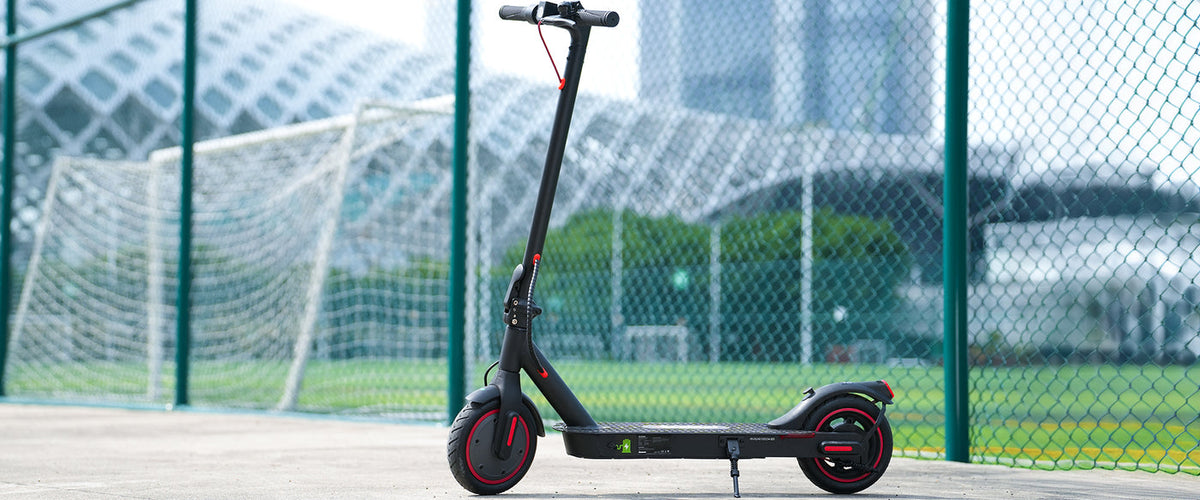
If you've spent any time browsing scooters online, you've probably noticed the terminology gets messy fast. Kick scooter, electric kick scooter, e kick scooter, stand up electric scooter, they all show up in search results, and it's not always clear whether they mean the same thing or something different.
Here's the short version: an electric kick scooter is a scooter you stand on and steer like a traditional kick scooter, but with a battery-powered motor that does some or all of the work for you. It's not the same as a moped, and it's not quite the same as a plain push scooter either. It sits in its own category, and understanding that category matters if you're trying to figure out which model actually fits how you get around.
This guide breaks down what the term really means, how it differs from a manual kick scooter, and where models like the iScooter i8, i9Max, and iX7Pro fit into the picture.
Electric Kick Scooter Explained: Why the Name Can Be Confusing
The confusion mostly comes down to overlapping language. "Kick scooter" originally referred to the simple, foot-powered scooters kids rode to school: no motor, no battery, just momentum from a push-off. Somewhere along the way, manufacturers started adding electric motors to that same basic frame, and the name stuck even though the mechanics changed.
So when you see "electric kickboard" or "electric standing scooter" in a listing, these are usually just regional or translated variations of the same product. Kickboard is common in some Asian markets; standing scooters show up more in general product descriptions, but they're all pointing at the same basic idea: a compact, motorized, stand-up ride.
The result is that shoppers searching for kick scooters sometimes land on pages for motorized ones, and vice versa. Reading the specs such as battery, motor wattage, range is really the only reliable way to tell which one you're actually looking at.
Kick Scooter vs Electric Kick Scooter: The Key Difference Is the Motor
A traditional kick scooter runs entirely on your own effort: no battery, no motor, nothing to charge. An electric kick scooter adds a motor, a battery pack, and a throttle, which changes both how it rides and what it's realistically used for. The table below breaks down where the two actually diverge.
|
Feature |
Kick Scooter (Manual) |
Electric Kick Scooter |
|
Power source |
Rider's own push-off |
Battery-powered motor |
|
Typical range |
A few blocks, limited by effort |
Several miles, depending on battery |
|
Startup |
Push to move, no throttle |
Push-to-start or throttle from standstill (varies by model) |
|
Best for |
Short, casual trips |
Daily commuting, longer distances |
|
Weight |
Lighter, fewer components |
Heavier, due to battery and motor |
|
Maintenance |
Wheels, bearings, folding hinge |
Same mechanical parts, plus battery care and charging |
How the i8, i9Max and iX7Pro Fit the Electric Kick Scooter Category
iScooter builds several models that fall squarely into this category, each aimed at a slightly different rider.
|
Model |
Max Speed |
Max Range |
Motor Power |
|
iScooter i8 |
18 mph |
12 miles |
Standard |
|
iScooter i9Max |
19 mph |
20 miles |
500W |
|
iScooter iX7Pro |
38 mph |
50 miles |
2000W (dual motor) |
iScooter i8 electric scooter
Built as an entry point. Lightweight, foldable, and easy to carry up a flight of stairs or tuck under a desk at work. It's a good fit for someone who wants the basics done well: reliable braking, a comfortable deck, and enough range for a daily commute without extra bulk.
iScooter i9Max electric scooter
Steps things up with a larger battery and more power, aimed at riders who want longer range or need to handle hillier routes. If your commute involves more than flat sidewalks, this is the kind of spec bump that actually matters day to day.
iScooter iX7Pro electric scooter
Sits at the higher end of the lineup, with upgrades to suspension and ride stability that make it better suited to less-than-perfect road surfaces. For riders who've outgrown a basic stand up electric scooter and want something that feels more planted at speed, this is where that upgrade shows up.
Manual Push vs Powered Ride: What Actually Changes Day to Day
It's worth being honest about what switching from a manual scooter to an electric one actually changes in practice, because the differences go beyond just "less effort."
|
Factor |
Manual Kick Scooter |
Electric Kick Scooter |
|
Propulsion |
Foot-powered push-off |
Battery-powered motor |
|
Typical Trip Length |
Short, walk-replacement distances |
Several miles, commute-length |
|
Effort Required |
Continuous pushing |
Minimal after initial push (model-dependent) |
|
Weight |
Lighter, easier to carry |
Heavier due to battery and motor |
|
Maintenance |
Mechanical only (wheels, bearings, hinge) |
Mechanical plus battery health and charging habits |
Choosing an Electric Kick Scooter for Your Commute
The right pick usually comes down to three questions: how far you're riding, what the terrain looks like, and how often you'll need to carry it rather than ride it. Short, flat commutes under a few miles don't need a huge battery, something closer to the i8 keeps weight down without sacrificing much practically.
Longer routes, or ones with real hills, are where the extra battery capacity on a model like the i9Max starts to pay off in range you won't have to think twice about. And if your commute includes rougher pavement, potholes, or uneven bike lanes, the added stability on something like the iX7Pro tends to make the ride noticeably less jarring.
There's no single "best" electric kick scooter, just the one that matches how and where you're actually riding it.
FAQs
Is an electric kick scooter the same as a regular (non-motorised) kick scooter?
No. They share the same basic stand-up design, but a regular kick scooter relies entirely on you pushing off with your foot, while an electric kick scooter uses a battery-powered motor to provide most or all of the propulsion once you're moving.
How is an electric kick scooter different from an electric moped?
An electric moped typically has a seat, higher top speeds, and is often classified closer to a low-powered motorcycle in terms of licensing and road rules. An electric kick scooter is ridden standing up, is lighter and foldable, and is generally built for shorter urban trips rather than sustained road travel.
Are electric kick scooters easier to store than other formats?
Generally yes. Most electric kick scooters fold down to a compact size that fits in a closet, under a desk, or in a car trunk, which is one of the main reasons they're popular for commuters who need to store the scooter indoors or bring it inside a workplace.
Share:
Hardtail vs Full-Suspension Electric Mountain Bikes: Which Suits UK Riders?
How Much Does an Electric Mountain Bike Cost in the UK? A 2026 Budget Guide