
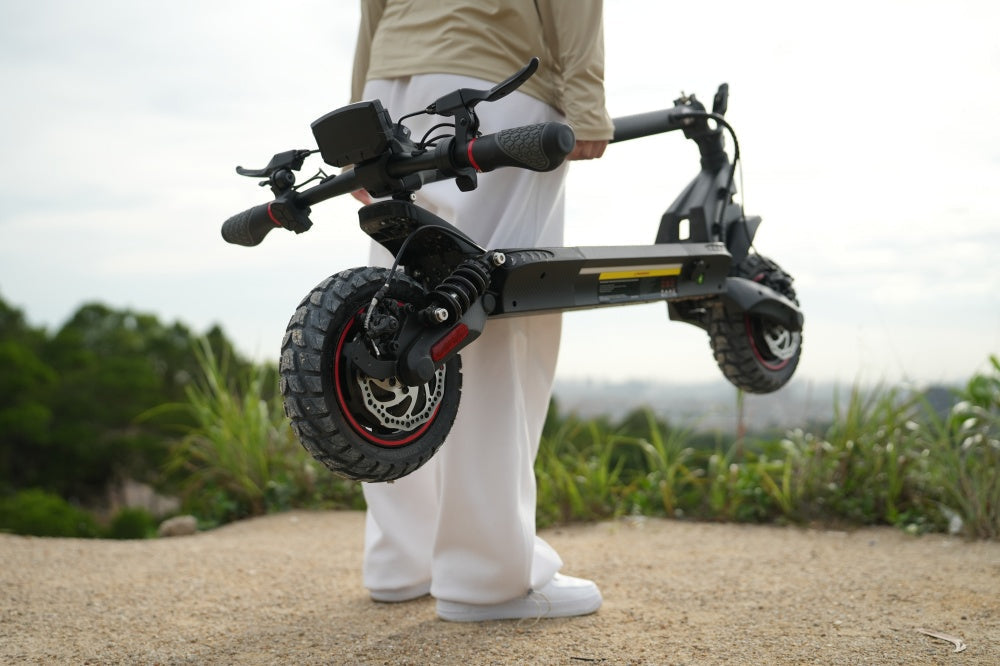
If you've been shopping around for a dual motor electric scooter, you've probably noticed that most listings throw around big numbers without explaining what they actually mean once you're on rough ground. "1000W" sounds impressive on paper, but does it translate into real climbing power, or is it just a spec sheet flex?
That's exactly what we're breaking down here, using the iScooter iX7Pro off-road electric scooter as our case study. By the end, you'll know what dual-motor power really buys you, how the suspension and brakes hold up their end of the deal, and whether this machine fits the terrain you actually ride.
What Does "1000W Peak, Dual Motor" Actually Mean?
A 1000W dual-motor electric scooter uses one motor in each wheel, sharing power instead of relying on a single motor. The result is better traction on loose surfaces and stronger hill-climbing performance.
When comparing models, don't just look at the headline wattage. Peak power is the short burst available for acceleration and steep climbs, while continuous power is what the motors can maintain over longer rides. Both matter, but peak output often makes the biggest difference when tackling hills or rough terrain.
Front Swing Arm and Rear Spring Suspension, Explained
Power alone doesn't make a scooter capable off-road, you need suspension that can absorb what the terrain throws at you. The iX7Pro pairs its dual-motor drivetrain with a front swing arm and rear spring shock absorber, a combination designed to soak up bumps rather than transfer them straight into your wrists and knees.
How Front and Rear Suspension Work Together
Here's the practical difference this makes: on a hardtail scooter with no suspension, every root, rut, or pothole becomes a jolt you have to brace for. With front and rear suspension working together, the wheels can move independently to track the ground, which keeps the deck more level and your ride noticeably smoother.
If you're riding an electric scooter with suspension uk trails that demands gravel paths, packed dirt, or uneven parkland this setup is what separates a comfortable ride from a bone-rattling one.
Why Suspension Improves More Than Comfort
It's also worth noting that suspension isn't just about comfort. A scooter that stays planted over bumps keeps more of its tire in contact with the ground, which means better braking and steering control when it counts.
The Long-Term Payoff for Frame and Ride Quality
There's a knock-on effect for the frame and electronics too. Every jolt that gets absorbed by the suspension is a jolt that doesn't travel up into the deck, the battery housing, or your joints.
Over months of regular riding on rough terrain, that adds up both in ride comfort and in how well the scooter holds up mechanically. A rigid off-road scooter without proper suspension tends to feel fine for the first few rides, then increasingly uncomfortable as the small impacts accumulate.
Why Off-Road Scooters Need Dual Disc Brakes
Off-road riding demands reliable stopping power, and the iX7Pro delivers with front and rear disc brakes plus a motor cut-off that instantly cuts power when you brake.
Disc brakes perform more consistently than rim or drum brakes on wet grass, mud, and loose gravel, giving you better control when conditions change. Braking across both wheels also reduces the risk of skidding, making the scooter feel more stable and predictable when you need to stop quickly.
IPX4 Water Resistance and UK Weather
Anyone riding an off road electric scooter uk weather has to deal with knows that dry, sunny trail days are the exception, not the rule. This is where the iX7Pro's IPX4 water resistance rating earns its keep.
IPX4 means the scooter is protected against splashes from any direction, which covers rain, puddles, and wet grass without much drama. It's not a rating for full submersion but for the kind of unpredictable drizzle and damp trail conditions common across the UK, it's a sensible level of protection for a machine that's meant to be ridden outdoors, not stored in a garage.
Is the iX7Pro Built for Your Terrain?
So who is this scooter actually for? If your rides are limited to smooth pavement and bike lanes, a dual-motor off road electric scooter with full suspension is more machine than you need. A lighter commuter model would serve you better and cost less.
But if your regular route includes gravel tracks, muddy fields, grassy parks, or hilly terrain where a single motor and no suspension would leave you struggling, the iX7Pro's combination of power, traction, suspension, and braking is built specifically for that use case.
It's also worth thinking about where you'll store and charge it, since off-road scooters with this kind of drivetrain and suspension tend to be heavier than city commuters. That trade-off is the price of capability, you're carrying more hardware because that hardware is doing more work when the ground gets rough.
Battery range is another practical factor. A dual-motor setup draws more from the battery than a single-motor scooter under the same conditions, especially when climbing or riding through soft ground where the motors have to work harder to maintain speed.
If you're planning longer off-road outings rather than short loops around the block, it's worth checking the battery capacity alongside the motor specs, since the two work together to determine how far you can actually go before needing a recharge.
If you want the full breakdown of specs, weight, and charging times before deciding, the iScooter iX7Pro product page has the complete details laid out.
FAQs
How does the iX7Pro's 15.5 mph top speed feel in real-world riding?
On paved, flat ground, 15.5 mph feels brisk but controlled. Off-road, that same top speed feels considerably faster, since uneven surfaces, loose gravel, and grass all add resistance and reduce your margin for reaction time. Most riders find they rarely hold top speed off-road for long, the terrain naturally has you modulating throttle, which is where the dual-motor torque and suspension do their real work.
Can the iX7Pro handle gravel and grass on private land?
Yes. The dual-motor drivetrain and front-and-rear suspension are designed for exactly this kind of mixed, uneven terrain, giving better traction and a smoother ride than a single-motor scooter without suspension would manage on the same ground.
How long does the 504Wh battery take to recharge from empty?
Charging time depends on the charger's amperage and the battery management system's final-stage taper, so it's worth checking iScooter's official spec sheet or the included manual for the exact figure on this model. As a general rule, the last 10–20% of any charge takes noticeably longer than the rest, since the battery management system slows the charge rate to protect long-term battery health.
Share:
Electric Mountain Bikes Explained: What UK Riders Should Know Before Buying
Why Off-Road Electric Scooters Are Britain's Fastest-Growing Ride for 2026