
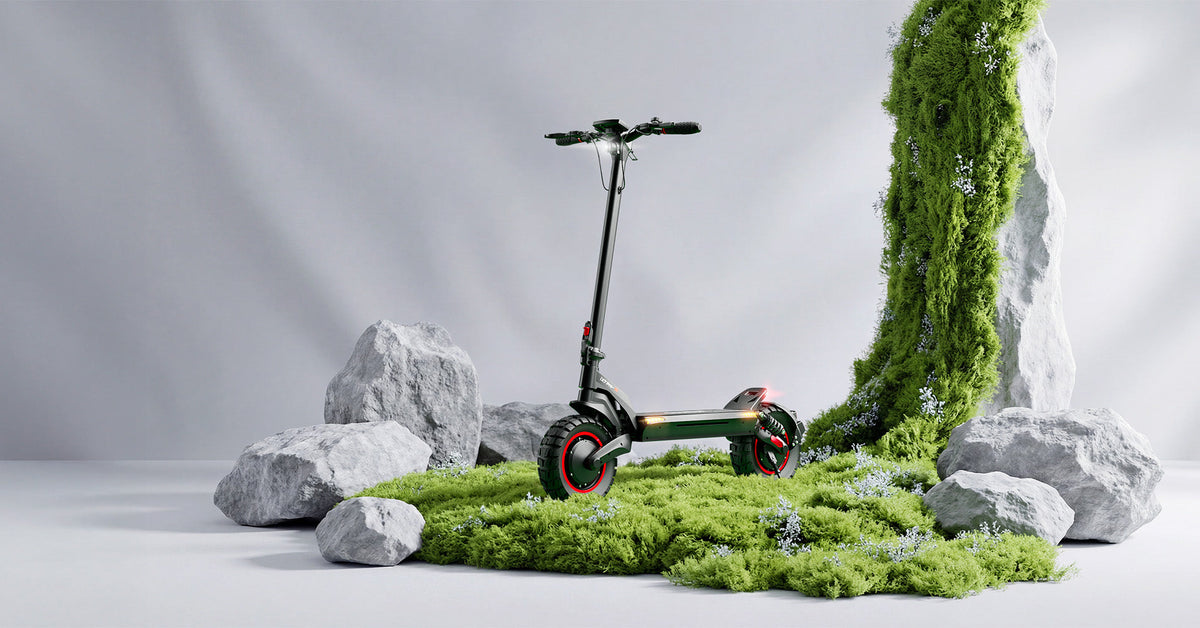
If you own a sloping paddock, a farm track or a hillside trail loop, you already know the problem. A scooter that feels lively on the flat can run out of steam halfway up the first rise. So which is the best electric scooter for hills UK riders can actually use on private land?
The answer starts with one number most buyers skip: the hill climb percentage. This guide explains what that rating means, why wattage alone can mislead you, and how the iScooter iX7Pro and iX5S compare on a slope.
What Does a "35% Hill Climb" Actually Mean?
A hill climb rating describes steepness. A 35% gradient means the ground rises 35 metres for every 100 metres you travel forward. In angle terms, that is roughly 19 degrees. A 20% slope is about 11 degrees, and 25% is about 14.
Those angles sound modest until you are on them. Anything above a gentle incline asks a lot of a small motor, because it has to push the rider and the scooter against gravity the whole way up.
Here is the catch. A hill climb figure is a manufacturer-listed rating, not a promise for every surface and every rider. Still, it is the fairest starting point for comparing an electric scooter for uphill work, because it is measured against the slope itself rather than an abstract power number. The iScooter iX7Pro lists a 35% hill climb. The iX5S lists 20–25%. That gap matters more than it first appears, and the next section explains why.
Motor Power vs Gradient Rating: Why Watts Alone Mislead
Most shoppers searching for a powerful electric scooter compare watts and stop there. It feels logical, but wattage tells you how much power a motor can produce. It does not tell you how well that power is put on the ground when the slope tilts against you.
Think of two people carrying a heavy bag up a staircase. One has strong legs but poor grip. The other has decent legs and a solid hold. The second person gets to the top more reliably. E-Scooters work the same way.
Gradient rating blends several things into one practical figure: motor output, how many wheels are driven, and how the whole system holds up under load. That is why we suggest treating the gradient percentage as the number to compare, with wattage as supporting evidence.
Two details separate the models here:
-
Peak motor power: the iX7Pro lists a 2000W peak, while the iX5S is listed at 1000W.
-
Drive layout: the iX7Pro uses dual-wheel drive, so both wheels share the work of pulling you up the incline.
Peak power is the short burst a motor can deliver, which is exactly what a steep pitch demands. Dual-wheel drive helps because two driven wheels share the effort, so one slipping on loose ground does not leave you with nothing.
For a deeper look at how a dual-motor setup behaves away from tarmac, our guide to what 1000W dual motor power means off-road walks through it in plain language.
Best Electric Scooter for Going Up Hills: iX7Pro vs iX5S Side by Side
If you want the best electric scooter for going up hills among the two, the listed figures point clearly to the iX7Pro. Here is how they sit next to each other, using only the specs listed on each product page.
|
|
iScooter iX7Pro |
iScooter iX5S |
|
Listed hill climb |
35% |
20–25% |
|
Motor power |
2000W peak |
1000W |
|
Drive |
Dual-wheel drive |
See product page |
iScooter iX7Pro off-road electric scooter
Is the one to look at if your land has genuinely steep sections. A 35% rating, a 2000W peak and dual-wheel drive add up to the strongest uphill setup in this comparison. It is the electric scooter that can go uphill where the ground gets properly demanding.
iScooter iX5S
Is still a capable choice. A 20–25% rating suits rolling paddocks, gentler farm tracks and trail loops where the slopes are more of a lean than a wall. If your steepest section is moderate, it may be all you need.
A simple rule of thumb: measure or estimate the steepest part of your land first, then pick a rating with some headroom above it. Buying right at the limit leaves you with no margin when the ground is wet or the battery is low. You can also browse the full off-road electric scooter collection to see where each model fits.
What Slows a Scooter on a Slope: Rider Weight, Surface and Battery
Even the best uphill electric scooter will not climb at its rated figure every time. Three things change the result.
Rider weight
Gravity pulls harder on a heavier load, so the motor works harder for the same incline. A listed rating assumes certain conditions, so a heavier rider or extra gear can mean a slower climb. Always check the maximum load on the product page before buying.
Surface
Dry, firm ground gives the tyres something to bite. Wet grass, loose gravel, mud and soft soil all reduce grip, and a wheel that spins is a wheel that is not climbing. This is another reason dual-wheel drive earns its place on a slope.
Battery state
A fresh battery supplies power more steadily. As charge drops, output under heavy load can fade, and a long climb is one of the hardest things you can ask of a battery. Starting a steep section on a low charge is the surest way to slow down halfway up.
Slope length matters too. A short, sharp rise is easier than a long, steady climb, because the second keeps the motor and battery under strain for much longer. Braking is part of the same story, since what goes up must come down. Our piece on suspension, brakes and balance on UK rides covers how the chassis is set up for control.
Choosing a Powerful Electric Scooter UK Riders Can Use on Private Land
A powerful electric scooter UK buyers choose for hills should be matched to the land, not to the biggest number on a spec sheet. Work through these in order:
-
Find your steepest slope. Everything else depends on it.
-
Add headroom. Pick a hill climb rating comfortably above that slope.
-
Check the drive. Dual-wheel drive helps on loose or wet ground.
-
Think about your weight and kit. Compare it with the stated maximum load.
-
Keep it on private land. Check the current UK rules for e-scooters before you ride anywhere else, as they are not legal on public roads or pavements.
That last point is important. These are off-road scooters, designed for use on private land with the landowner's permission.
For a steep hillside, the iX7Pro is the clearer pick on the figures listed. For gentler terrain, the iX5S gives you a capable and simpler option. Either way, compare gradient first and wattage second, and you will avoid the most common buying mistake. If you are still unsure, look through the off-road range and match the listed hill climb to the steepest part of your land.
FAQs
Does a steep hill drain an electric scooter battery faster, and by how much?
Yes. Climbing asks the motor for more power than flat riding, and that pulls charge from the battery faster. The exact difference depends on the slope, your weight, the surface and how long the climb lasts, so there is no single figure that fits every ride. As a practical habit, start steep sections with a well-charged battery and keep some charge in reserve for the return trip.
Is it safe to ride downhill on an off-road electric scooter, and which brakes matter most?
It can be, if you control your speed. Descents put a lot of load on the brakes, so ease off early rather than braking hard at the last moment. Reliable, well-maintained brakes matter most on a slope, so check them before each ride, and keep your weight balanced over the deck. Our guide to suspension, brakes and balance explains what to look for.
What rider weight can an off-road electric scooter climb a slope with?
Every model has a stated maximum load, and that is the limit to respect. Within it, a heavier rider will usually climb more slowly than a lighter one on the same slope, and the effect is more noticeable on loose ground. Check the maximum load listed on the product page for the iX7Pro or iX5S before you buy.
Share:
Electric Scooter With Lights for Adults: What Comes Built In
Is the iScooter i9 Worth It? 18.6 Miles, Solid Tyres and What You Give Up